The Leak That Starts Under Your Feet
Almost every Keller home is built on a slab: one continuous concrete pour that is both your floor and the base the house stands on. The water lines and drains run through and under that slab before reaching any faucet or drain in the house. So when a buried line fails, the water can't spill out where you'd see it. It pushes up through the concrete into your flooring or spreads sideways through the soil beneath the foundation. The leak is well underway before there's anything to notice, which is why slab leaks are so routinely caught late.
Keller's Mixed Soils and What They Do to Buried Pipe
Keller sits in the Eastern Cross Timbers, a transition zone where sandy loam gives way to expansive clay, sometimes within the footprint of one house. That matters more than it sounds. When part of a lot holds a clay that swells and shrinks hard with the seasons and another part sits on more stable sandy soil, the ground under the slab doesn't move as one piece. It flexes unevenly, and a pipe crossing that boundary gets stressed at a single point rather than gradually along its length. Over years of wet-dry cycles, that concentrated stress is what cracks a fitting or wears through a copper wall, and it's a pattern you see less in the uniform prairie clay elsewhere in the metroplex.
Reading the Early Signs Before the Damage Spreads
Slab leaks give warnings in a fairly predictable sequence. The first is usually a water bill that climbs with no change in your habits. Next might be a warm patch on a tile or wood floor where a hot line is leaking underneath, or the sound of water moving when every tap is closed. A damp area of flooring with no appliance and nothing overhead to explain it is a clearer sign, and the most advanced is the slab itself cracking or floor tiles shifting out of line. Any one of them justifies a professional moisture check before things progress.
What an Untreated Slab Leak Does to a Home
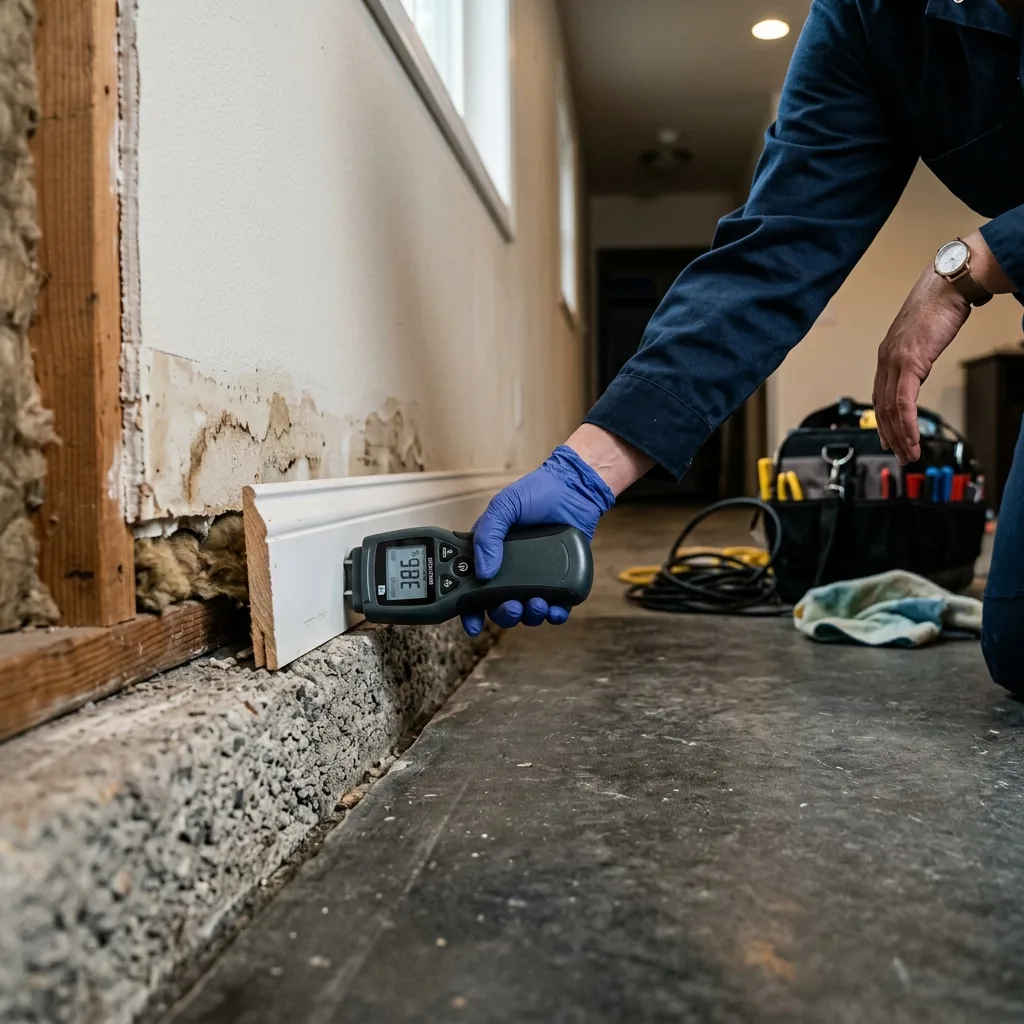
Left alone, a slab leak erodes the soil beneath the foundation as water keeps moving through it, hollowing out voids that let the slab settle unevenly, which on Keller's already-variable soils can accelerate the exact differential movement that caused the leak. Meanwhile moisture wicks upward into flooring and the base of your walls, and the enclosed wall cavities beside a wet slab grow mold within a couple of days. Each week the leak runs adds another layer of this secondary damage, turning what began as a plumbing repair into structural and mold work.
Locating and Drying a Slab Leak the Non-Destructive Way
Confirming a slab leak doesn't require tearing up your floor first. We use FLIR thermal imaging to trace where moisture is traveling through the slab and into the walls around it, then run extraction for any standing water and structural drying with LGR dehumidifiers aimed at pulling moisture out of the slab and the affected wall sections. Daily moisture readings continue until each zone reaches S500 drying goals, with antimicrobial treatment wherever framing or drywall paper was exposed to sustained water. The timeline follows the readings, not a set schedule, because the real scope depends on how far the moisture traveled.
Think you have a slab leak in Keller? Call (817) 761-5827. FLIR imaging confirms the moisture without opening your floor. Our burst pipe water damage service handles slab failures from extraction through drying through insurance documentation, with a vetted local crew across every Keller neighborhood.