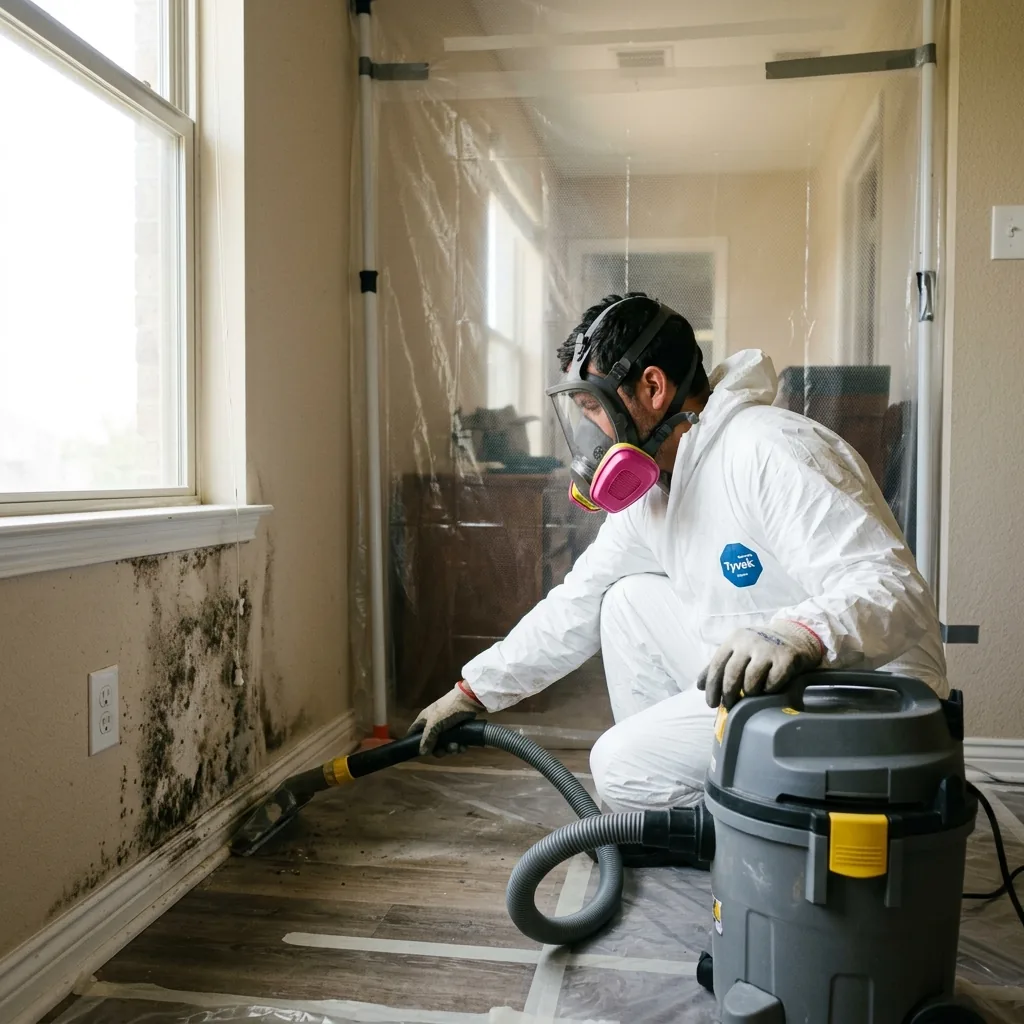
Mold needs moisture, and a North Texas summer supplies the humidity included. If a leak sat over a weekend, spores already have what they need. We contain before we touch anything, because disturbing a colony without containment spreads it.
A live dispatcher answers around the clock. The sooner the moisture source is cut, the smaller the remediation.
Dri-Eaz LGR dehumidifiers, Velo PRO air movers, and FLIR thermal imaging on every truck.
Fast extraction and structured drying stop mold before it starts, typically within 24 to 48 hours.
FLIR thermal mapping and moisture meters document every affected zone for your insurance adjuster.
Before any removal begins, we assess the full extent of visible and suspected mold growth. FLIR thermal imaging identifies hidden moisture areas that haven't yet shown visible mold. Containment is established with plastic sheeting and negative air pressure to prevent spore spread.
Mold-affected porous materials that can't be adequately cleaned are removed: drywall, insulation, carpet pad, and wood framing where growth is beyond surface level. Hard surfaces are cleaned with HEPA vacuuming and antimicrobial treatment, with removed materials disposed of per EPA guidelines.
After material removal, all remaining surfaces in the affected area are treated with EPA-registered antimicrobials. HEPA air filtration runs throughout the remediation process to capture airborne spores.
If moisture is still present after remediation, Dri-Eaz equipment continues drying to ANSI/IICRC S500-2021 goals. Complete full remediation documentation is provided for your insurance adjuster and any future property transaction.
Keller mold calls usually trace to one of three sources: a slab leak in a home sitting on soil that moves with the season, a supply line weeping inside a wall cavity, or an HVAC closet that has been condensing all August. We stop the moisture first, because remediation without a source repair only buys a few months. Then containment goes up, HEPA scrubbers run under negative pressure, affected material comes out, and an independent assessor handles clearance testing.
Wiping a wall is not remediation. What matters is whether the water that fed the growth is gone, and whether the spores you stirred up left the building instead of moving into the next room. Texas licenses mold assessment and remediation through TDLR, and larger projects require a written protocol and vetted personnel. We follow that process and bring in an outside assessor, because our own sign-off is worth less to you than an independent one.
Live dispatcher every call, day or night. No voicemail, no answering service.
Vetted local technicians working to the ANSI/IICRC S500 drying standard on every job.
From extraction to mold prevention, one crew handles the full restoration process.
Locally operated in Keller, not a franchise call center. We know every neighborhood.
What we find behind the wall decides the scope. These are the two mold situations we see most in Keller homes.
Problem: Water damage that wasn't dried to IICRC S500 goals, whether from a DIY attempt, a delayed response, or an underequipped contractor, leaves residual moisture that can grow mold within 24 to 48 hours. The mold often appears behind walls or under flooring where the original moisture wasn't detected.
Our Solution: FLIR thermal imaging maps every moisture zone. Containment established, mold-affected materials removed, antimicrobial treatment applied, and the structure dried to a verified standard with full documentation.
Problem: Older housing stock near Old Town Keller can have aging plumbing prone to slow leaks behind walls or under flooring that go unnoticed for months. By the time it's noticed, growth can span multiple wall cavities.
Our Solution: Thermal imaging identifies the moisture source and full affected area. Targeted drywall removal exposes and removes all visible growth, with antimicrobial treatment and source repair coordinated before resealing.
Texas licenses mold assessment and remediation through TDLR, and projects above the state size threshold require vetted personnel working to a written protocol. Ask to see current licensing before any work starts.
Because the moisture source is still active. In Keller that is often a slab leak, a weeping supply line inside a wall, or an HVAC closet condensing through summer. Remediation without a source repair only buys months.
Not on porous material. Bleach may lighten the surface while the growth continues inside drywall or wood, and spraying disturbs spores without containment. Sealed hard surfaces are a different matter and can be treated.
An independent assessor, not us. A company that certifies its own remediation has an obvious conflict, and an outside clearance result is worth considerably more to you and to your insurer.
✓ ANSI/IICRC S500 Drying Standard
✓ OSHA Compliant, Vetted Local Technicians
✓ Locally operated in Keller, not a franchise
Fast extraction after water damage reduces the moisture window that allows mold to colonize.
Drying to ANSI/IICRC S500-2021 goals within 24 to 48 hours is the primary mold prevention step after any water damage event.
Roof leaks and attic pipe failures that drain through ceiling assemblies are common mold triggers.
Skip the form — call Keller Rapid Restoration directly for the fastest response.
Available 24/7 · No-obligation estimate · Fast local response