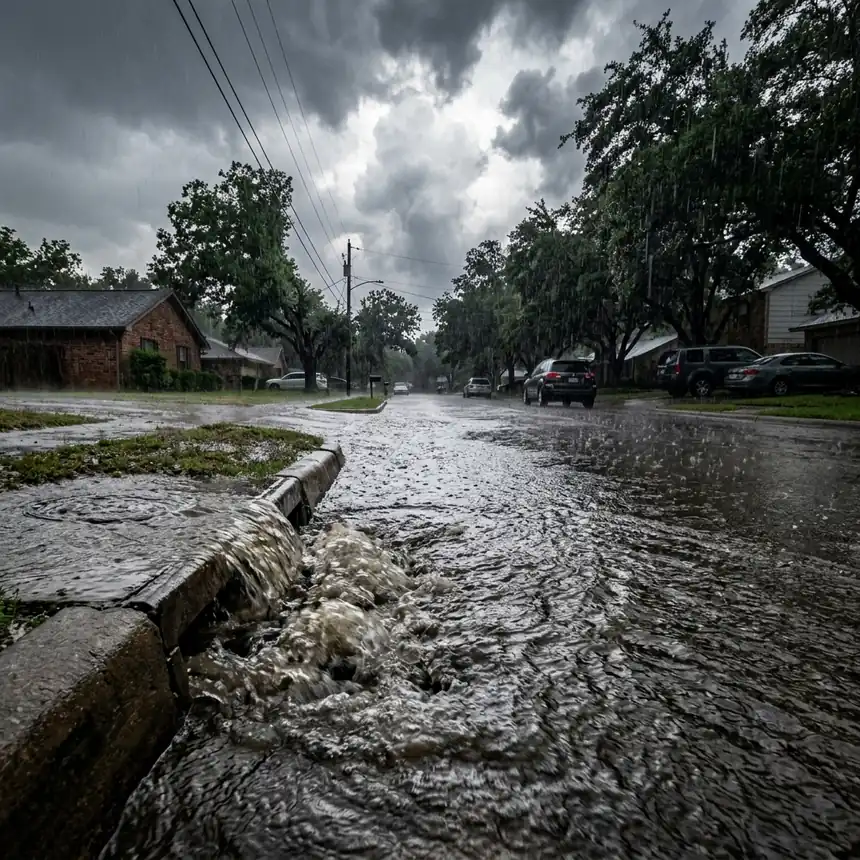
One Hour: How Fast Big Bear Creek Can Rise
The City of Keller's own flood-awareness guidance is blunt about it: Big Bear Creek can rise to dangerous levels in as little as one hour during a heavy storm. That speed is the whole story. A slow-rising river gives you a day to react; a flash-prone creek gives you the length of a downpour. Homeowners who assume they'll have time to move cars, sandbag a door, or clear belongings often find the water arrived while they were still deciding whether it would. Planning has to happen before the storm, because during it there isn't time.
Why Keller's Drainage Can't Keep Up With a Cloudburst
Keller's storm drains manage steady rain without trouble. They were never sized for the multi-inch-in-a-few-hours events North Texas springs produce on short notice. When rain falls faster than the system can carry it away, the overflow heads for the lowest point available, frequently a foundation, a threshold, or a low wall penetration. On Keller's rolling terrain that runoff concentrates quickly, and a home sitting downhill from its neighbors can take water they never see.
Flash Flooding Reaches Homes Far From the Creek
Proximity to Big Bear Creek raises the risk most, especially near Bear Creek Park and the Big Bear Creek Greenbelt, but the creek corridor isn't the only exposure. When the whole drainage system surges at once, water backs up through shared infrastructure and can push into homes a real distance from any visible channel. A house doesn't have to overlook the creek to flood in the same storm the creek does.
Check Your Flood Zone, Then Your Policy
Look up your address at the FEMA Flood Map Service Center, msc.fema.gov; it returns your zone in seconds. Zone AE is the mapped 100-year floodplain with a base flood elevation, and a lender almost certainly requires NFIP flood insurance there. Zone X is moderate risk with no requirement, but on a fast-rising creek that regularly matters less than the map suggests: the storms that flood AE homes reach X homes too when the creek surges. Knowing your zone is step one; confirming you actually carry the right policy is step two.
Storm Water Is Category 3, Handle It Accordingly
Floodwater from a creek or overwhelmed drainage is Category 3, contaminated from crossing the ground and the storm system, and it carries genuine health risk. A household shop vac can't pull the moisture out of walls and subfloor, and that hidden moisture is where mold begins within 24 to 48 hours. The job calls for professional extraction and disinfection, and given how fast Keller flooding arrives, calling early matters even more here than elsewhere.
Getting Ahead of the Next Fast Rise
If you're near Big Bear Creek or any low part of Keller, check your FEMA zone before storm season and, if you're in Zone AE without NFIP coverage, call your agent now. A vetted surveyor can prepare an elevation certificate that may lower your NFIP premium if your home sits above base flood elevation; pricing depends on the property, so get a direct quote. Since the creek won't give you an hour's grace to shop for coverage mid-storm, the preparation only counts if it's done in advance.
We respond across every Keller neighborhood, 24/7. Our flood damage restoration service runs from Category 3 extraction through structural drying and mold prevention. If a storm has already caused intrusion, call (817) 761-5827, a live dispatcher answers every call, whether you're near Silverleaf or anywhere else in the city.