Decoding the Restoration Alphabet Soup
Not every set of initials on a company's website carries weight. Some name the standards body that governs the trade, some name what an individual technician was trained to do, and one names a license Texas legally requires. Sorting which is which is how you avoid being impressed by letters that mean nothing. Below, each term in the order it actually matters when you're hiring.
Who Is the IICRC, and Why Adjusters Care
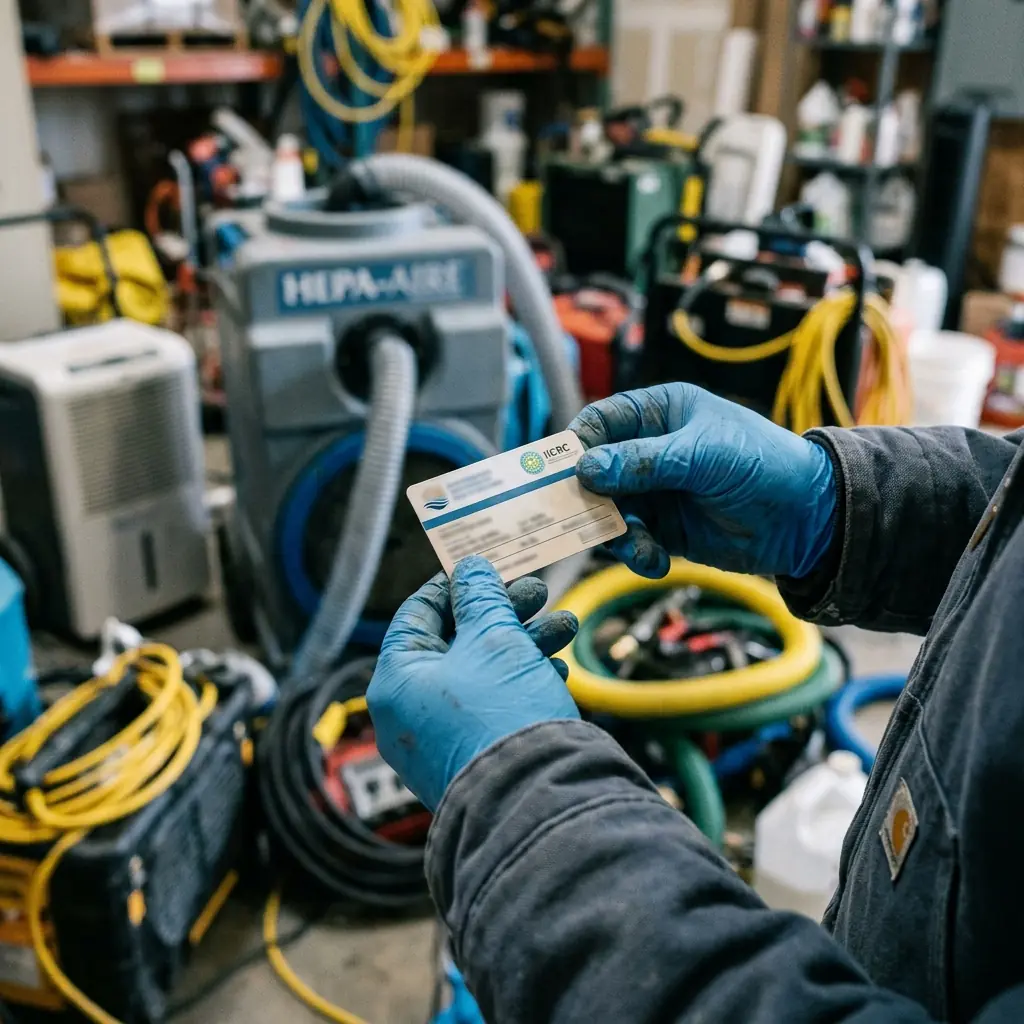
Start with the source. The IICRC (Institute of Inspection, Cleaning and Restoration Certification) is an ANSI-accredited body that writes the technical standards for the trade, most importantly ANSI/IICRC S500 for water damage and S520 for mold. The reason this matters beyond bragging rights: insurance adjusters, property managers, and code officials all measure a job against these standards. When your adjuster evaluates the work, S500 is the yardstick, so a crew that ignores it is building you a claim problem.
WRT and ASD: What Each One Actually Covers
These two describe what a technician was trained to do. WRT (Water Restoration Technician) is the foundation, covering how water behaves in a structure, moisture measurement, psychrometrics, and the Category and Class system used to classify a loss. ASD (Applied Structural Drying) sits on top of WRT and covers designing and running a drying system for more complex assemblies. Every technician we send in Keller holds WRT at least, and our senior crew holds ASD, which they apply on every structural drying job. The question to ask isn't whether the company is certified, but which of these the person at your door holds.
What the S500 Standard Makes a Crew Do
S500 isn't abstract; it dictates the actual work. It sets requirements for assessment and documentation, extraction, drying-system design, how often moisture gets monitored, antimicrobial use, and the final paperwork your insurer needs. The visible proof a crew followed it is the drying log, a daily record of moisture readings at each monitored spot showing the structure truly reached dry. Ask a Keller company if they'll hand you those logs; the answer tells you whether they measure or eyeball.
The License Texas Actually Requires
Here's the one that's not optional. Everything above is voluntary certification, valuable, but not law. A TDLR (Texas Department of Licensing and Regulation) Mold Remediation Contractor license is required by Texas law for any mold remediation, and a company doing mold work without one is operating illegally. So IICRC certification tells you a crew works to standard; the TDLR license tells you they're legally allowed to do mold work at all. A full-service Keller contractor should have both.
Checking a Crew's Credentials in Five Minutes
All of this is verifiable, so verify it. Individual IICRC credentials are searchable at iicrc.org and show the technician's name, credential, and expiration, and since they require continuing education, an expired one doesn't count. The TDLR mold license is searchable at tdlr.texas.gov. Confirm the lead technician's WRT before work begins and the mold license before any remediation. It takes five minutes and it's the least expensive insurance you'll buy on the whole job.
Every Keller job is worked to the ANSI/IICRC S500 standard, with a drying log you can check. Call (817) 761-5827 for emergency water damage restoration, where a crew arrives, extractors pull the standing water, and moisture monitoring starts immediately, worked to ANSI/IICRC S500-2021, from Silverleaf to Overton Ridge.